Axis regenerative medicine uses your own blood products to heal musculoskeletal injuries.
Medical science is moving faster than ever, turning possibilities into real solutions. One of the most exciting breakthroughs leading this change is regenerative medicine.
What makes it special? Instead of relying only on surgery, it helps your body do what it was naturally designed to do—heal itself. Think about how a cut closes or a bone repairs after a fracture. Regenerative therapy strengthens that very power.
Using orthobiologics, often prepared from your own blood or cells and rich in growth factors, these treatments encourage faster and better recovery. They are now widely used for ACL injuries, meniscus damage, and many spine and joint problems.
As the name suggests, this therapy uses platelets to support healing in damaged areas. A sample of the patient’s blood is processed in the lab to concentrate the platelets—creating a preparation more advanced than PRP. It is then injected into the affected site. Rich in growth factors, platelets help stimulate tissue repair and speed recovery…Read More
Another regenerative option at Axis Clinics is plasma lysate therapy. Plasma taken from the patient’s blood is processed to break it down at the cellular level, releasing key growth factors and cytokines. Injecting these around affected nerves supports healing and helps relieve pain caused by disc problems….Read More
In regenerative therapy, blood is not the only source of orthobiologics—bone marrow is another powerful option. Located at the center of bones, bone marrow is rich in healing cells and growth factors that activate after injury. In this procedure, marrow is collected (bone marrow aspirate), processed the same day with minimal manipulation, and concentrated to create bone marrow aspirate concentrate. This orthobiologic is then used to promote healing and reduce pain at the damaged site. Because it is prepared and used on the same day, the treatment is called SDBMAC…Read More
Platelet-rich plasma (PRP) is a widely used regenerative therapy made from the patient’s own blood. The sample is centrifuged to concentrate platelets packed with growth factors. These help stimulate tissue repair, support cell regeneration, and reduce inflammation. PRP is commonly used across many specialties, especially in orthopaedics…Read More
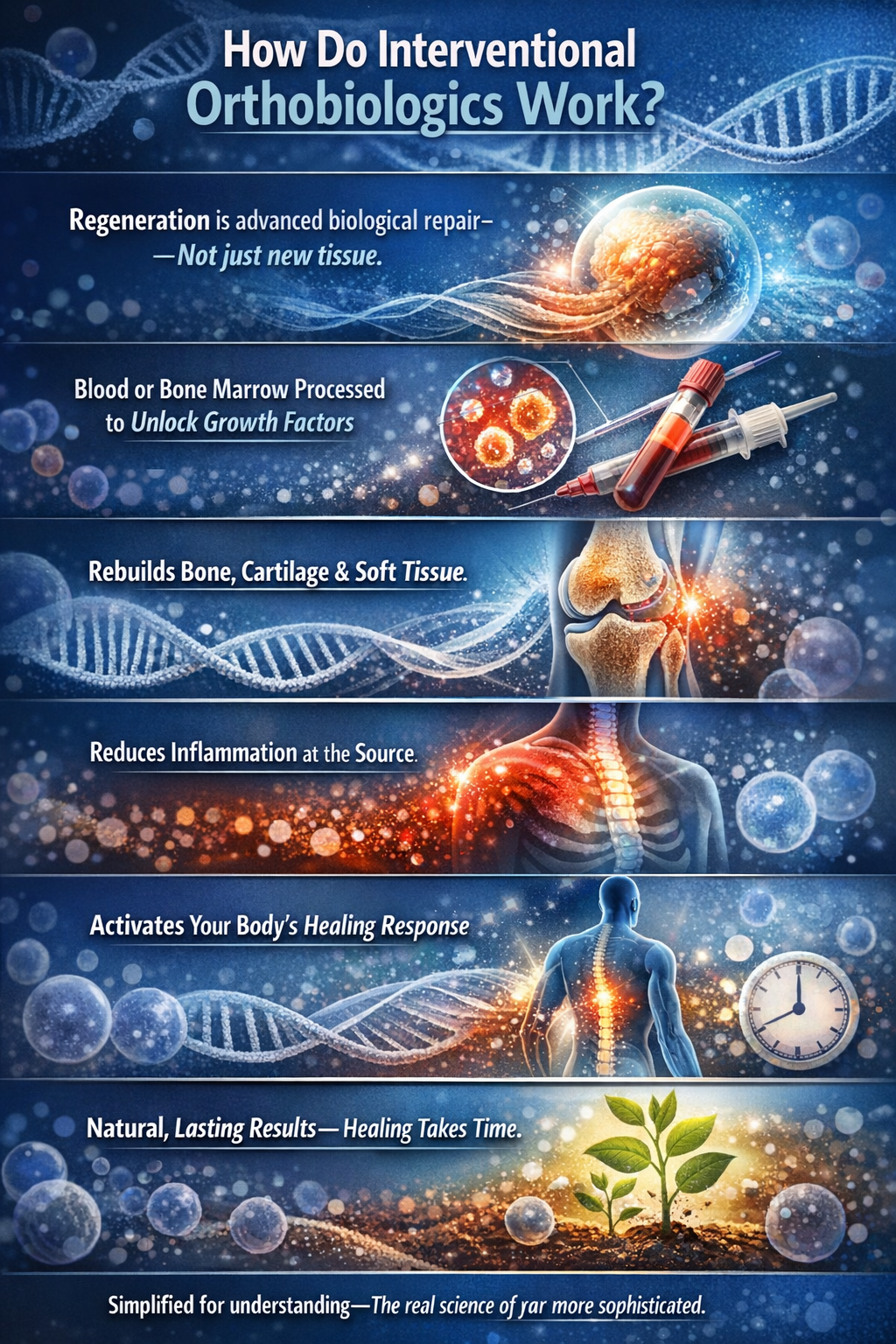
Regeneration is advanced biological repair—not just new tissue.
Blood or bone marrow is processed to unlock concentrated growth factors.
These fuel the rebuilding of bone, cartilage, and soft tissue.
Orthobiologics reduce inflammation at the source.
They activate your body’s own healing response for stronger recovery.
Healing takes time, but the results are natural and durable.
Simplified for understanding—the real science is far more sophisticated.
Regenerative medicine is transforming orthopaedic care by helping treat many injuries without surgery. Even conditions once thought to require an operation—such as degenerative disc disease and certain slipped disc problems—may benefit from these therapies.
Ligament injuries (including ACL): While complete tears may still need surgery, partial injuries can often heal with regenerative support. The treatment promotes tissue repair and healthy scar formation around the damaged ligament.
Other sports injuries: Damage to cartilage and soft tissues can also respond well, encouraging recovery where healing is usually slow.
Recovery & downtime: Improvement is gradual but sustained. Because these therapies reduce inflammation and stimulate natural repair, recovery can be quicker and less disruptive than surgical options.
Bridges the gap between medicines and surgery
Minimally invasive — no large incisions
Faster, smoother recovery than traditional procedures
Less pain and reduced inflammation
Quicker return to daily life
Uses your own blood, so reaction risk is minimal
No donor-blood compatibility concerns
Regenerative medicine offers minimally invasive solutions for many injuries once considered treatable only with surgery. If you’re struggling with orthopaedic or pain issues, expert help is within reach.
Get in touch today for a personalized estimate and book a consultation with the experts at Axis Clinics.
Email: contact@axisclinics.com | Call: +91 9019003600